
The S&P 500 officially fell to bear market levels this week. Rapid inflation across the economy has affected consumers and businesses, raising questions about spending and corporate profits. These pressures have pushed interest rates higher across the curve, breaking a four-decade pattern of falling yields. This has prompted the Fed to tighten more quickly, with some now expecting a 75 basis point rate hike this week. Altogether, these events have led investors to swiftly re-evaluate asset prices across financial markets, resulting in steep declines this year.
For all investors, this is a challenging period that can be financially and emotionally stressful. In times like these, it’s important to remember that staying patient and disciplined in times of market volatility is one of the core principles of long-term investing. This is because markets fluctuate on a regular basis in response to a variety of market, economic and geopolitical factors (see chart below). Having the knowledge and experience to separate important changes in long-term trends from short-term reactions can help investors to be positioned for future opportunities.
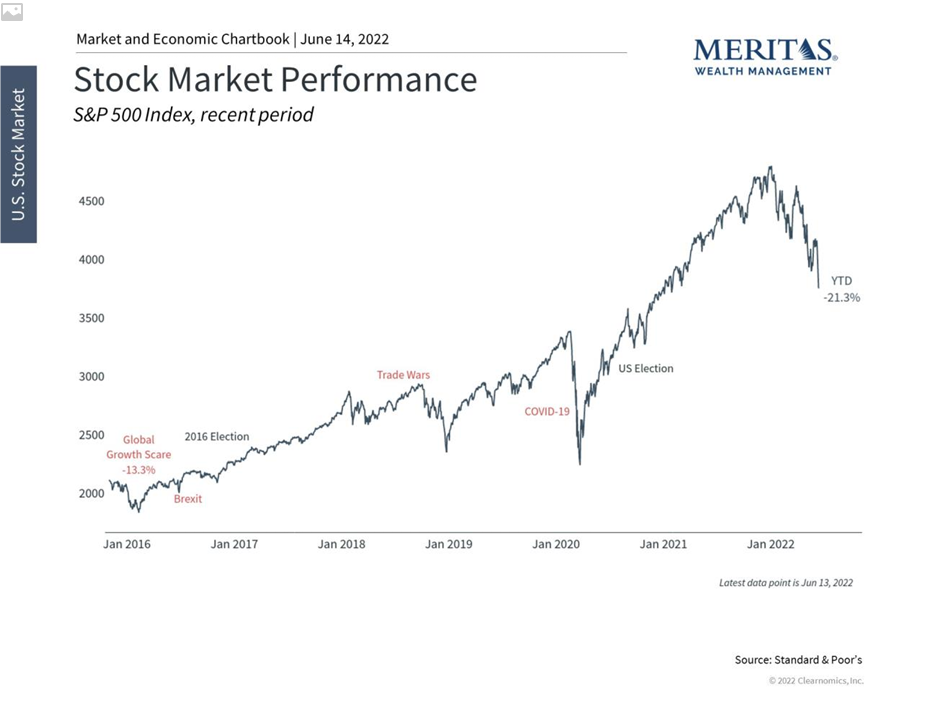
In The Intelligent Investor, Benjamin Graham, the father of value investing and Warren Buffet’s mentor, wrote a parable about a manic investor, “Mr. Market.” Every day, Mr. Market offers to buy or sell you stock at a price based not on the fundamental value of the asset but on his mood.
In many cases, this mood is determined by what the stock has done in the past day or two, not by a more objective measure of what it is worth. In many cases, the rational investor could choose to ignore the price swings proposed by Mr. Market, especially if they have studied market history. This is true no matter how large the fluctuations or whether we assign them labels such as “correction” or “bear market.”
Unfortunately, it is human nature to be drawn to assets with prices that are rising and avoid ones that are falling. This is true even when this has little impact on what a stock may do
next. The irony is that when stocks are the most attractively valued, investors want them the least. Recent price movements should have little bearing on what an asset is truly worth, so learning to overcome this bias takes training, experience, and often the guidance of a trusted advisor. After all, many investors wish they had been more disciplined after the market began to recover in mid-2020.
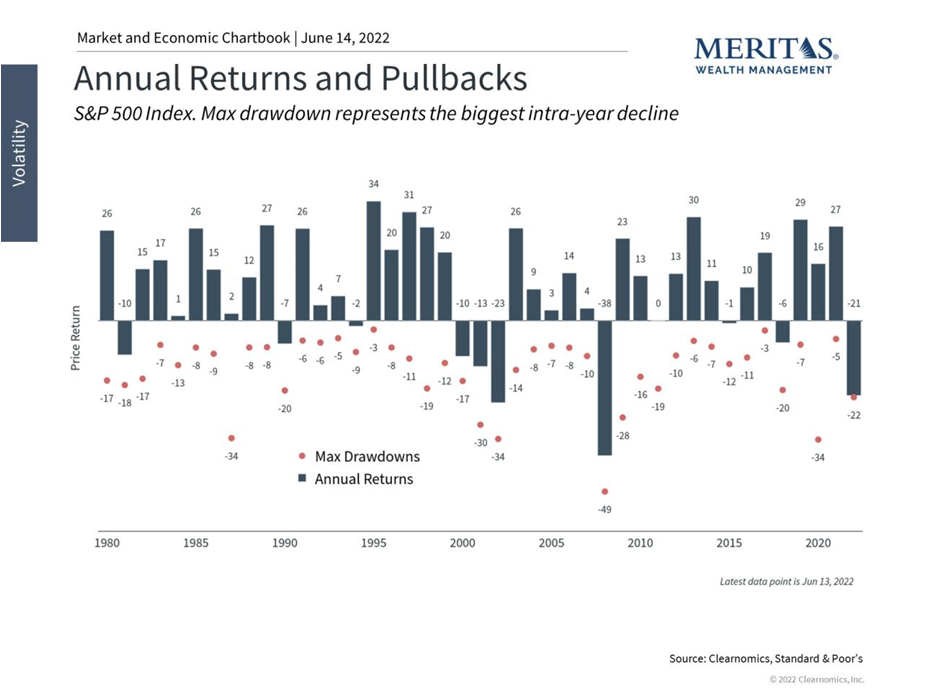
- This chart shows the performance of the stock market (bars) and the largest intra-year decline (dots) each year.
- The average year sees a stock market drop of -13.5%. However, most years still end in positive territory, averaging 9% gains.
- Volatility is a normal part of investing and investors are often rewarded for staying disciplined through short-term volatility.
Markets have been worried about increasing interest rates since inflation began to pick up a year and a half ago. Markets have been well ahead of the Fed which has, by their own admission, been behind the curve in responding to higher prices across the economy. It’s not difficult to argue that markets are pricing in the worst-case scenario of a Fed-induced recession in order to ease these price pressures. If this is the case, any unexpected slowing of inflation, e.g. if energy or food prices decline, would be viewed as positive for markets. This is especially true because the economy, by many other measures like the unemployment rate (see chart below), is still strong.
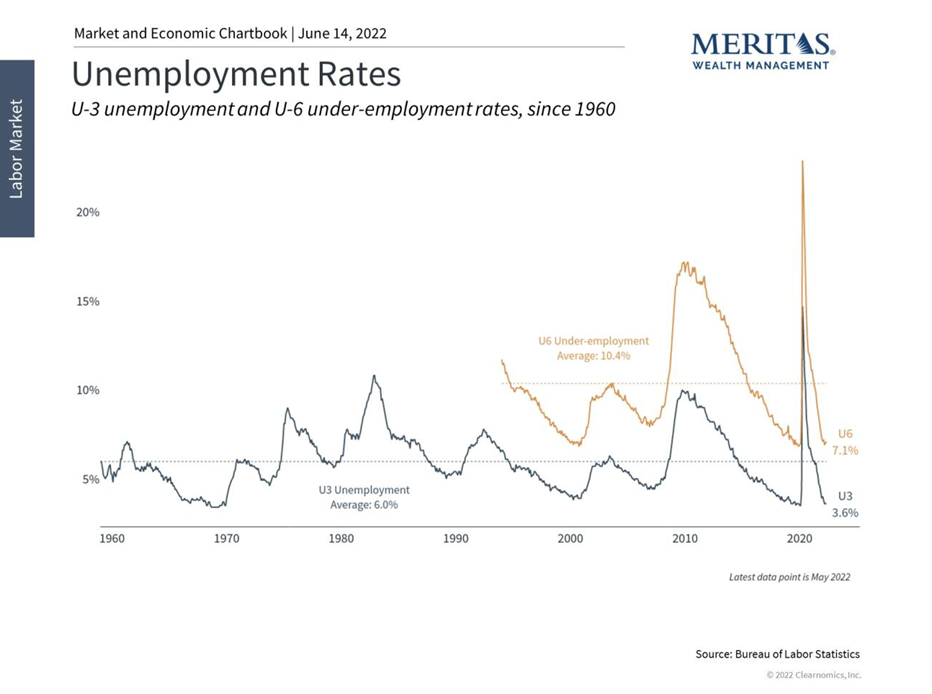
Unemployment is near historic lows due to the strength of the job market.
Even the so-called under-employment rate has fallen to near historic lows as jobs remain plentiful.
The balance between unemployment and inflation is a tricky one that the Fed will need to navigate.
The bottom line? As markets find a level and the inflation story evolves, it’s important for long-term investors to maintain perspective. Market corrections and even bear markets are normal. Not only do markets historically recover, but this can happen when investors least expect it. Although the S&P 500 is 21% below its all-time high, it has experienced similar or fewer major pullbacks this year compared to 2020, 2018, 2009 (when the market was rapidly recovering), and throughout the early 2000s. While these were all difficult periods, the best course of action was to stay patient, hold a balanced portfolios, and avoid being unduly influenced by Mr. Market.