The failure of Silicon Valley Bank on Friday morning was spectacular in both its size and speed (it was wholly solvent on Wednesday). It was the largest failure of a U.S. bank since the 2008 economic crisis. Friday afternoon, as companies started to make public the amount of cash they stood to lose from the bank’s closure, it was clear that it would take some time to comprehend the ripple effects of the loss of cash. Yesterday’s announcement by the Fed, Treasury Secretary Janet Yellen, and the FDIC that ALL deposits of Silicon Valley Bank (SVB) would be guaranteed by the federal government (not just insured deposits) should do much to reassure investors and bank depositors about the security of the banking system.
Silicon Valley Bank (SVB to insiders) was kind of unique in the banking industry. Unlike most banks that loan money to local residents, small businesses and corporations, SVB lent to a very exclusive group of companies: tech startups and venture-backed health care companies. Over its 40-year existence, the bank grew with the tech industry, eventually, becoming one of America’s 20 largest lending institutions, with $209 billion in total assets at the end of last year. With so many tech companies with large cash positions, over 90% of the bank’s deposits were uninsured. That left a lot of depositors feeling exposed and led to the run on the bank Thursday as depositors tried to withdraw $42 billion in one day!
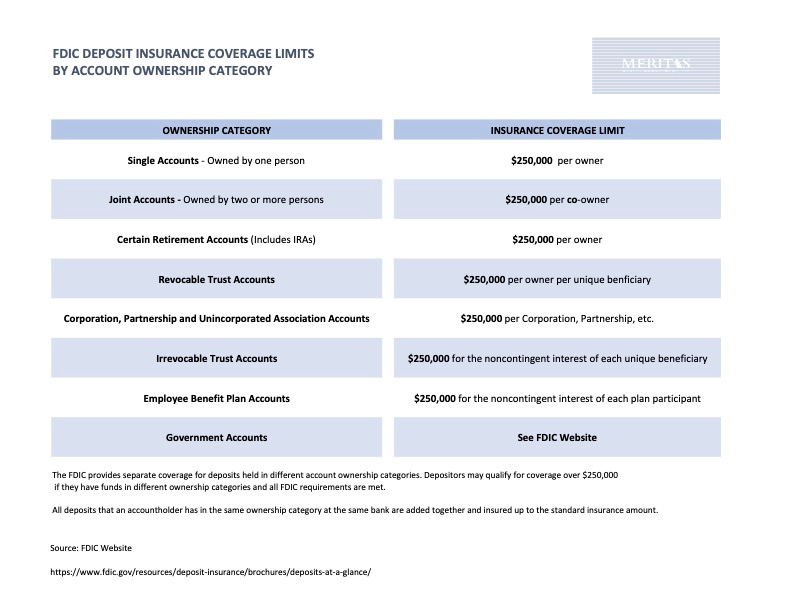
It is understandable that large companies with cash balances in the hundreds of millions of dollars can’t keep all their accounts insured by the FDIC (at $250,000 per bank)—that would involve far too many banks. Individuals and small business owners, on the other hand, can take this opportunity to remind themselves of the FDIC insurance limits. The attached chart summarizes the various ownership categories and the limit for each category. Generally speaking, the limit is $250,000 per owner per category. A jointly held account with two owners is insured up to $500,000. Unless stated otherwise, the FDIC assumes jointly held accounts are split equally (50% each for two people, 1/3 each for 3 people, etc.). It’s important to remember that the coverage limits apply to all accounts in that category.
Example: An individual has $150,000 in checking and savings accounts in their own name and $230,000 in a checking account with their spouse and a $40,000 CD with their spouse, as well. They are fully insured. The individual accounts are pooled together ($150,000) and that is covered by the $250,000 per single owner. The joint checking account and the jointly owned CD add up to $270,000 and that’s covered by $500,000 ($250,000 per joint owner).
Please review your cash positions and the ownership categories on the attachment and make sure you are fully insured. Call your Meritas team if you have any questions regarding whether you are fully insured or how to get fully insured if you are not.
Best regards,
The Meritas Team